

Date : Feb-18-2026
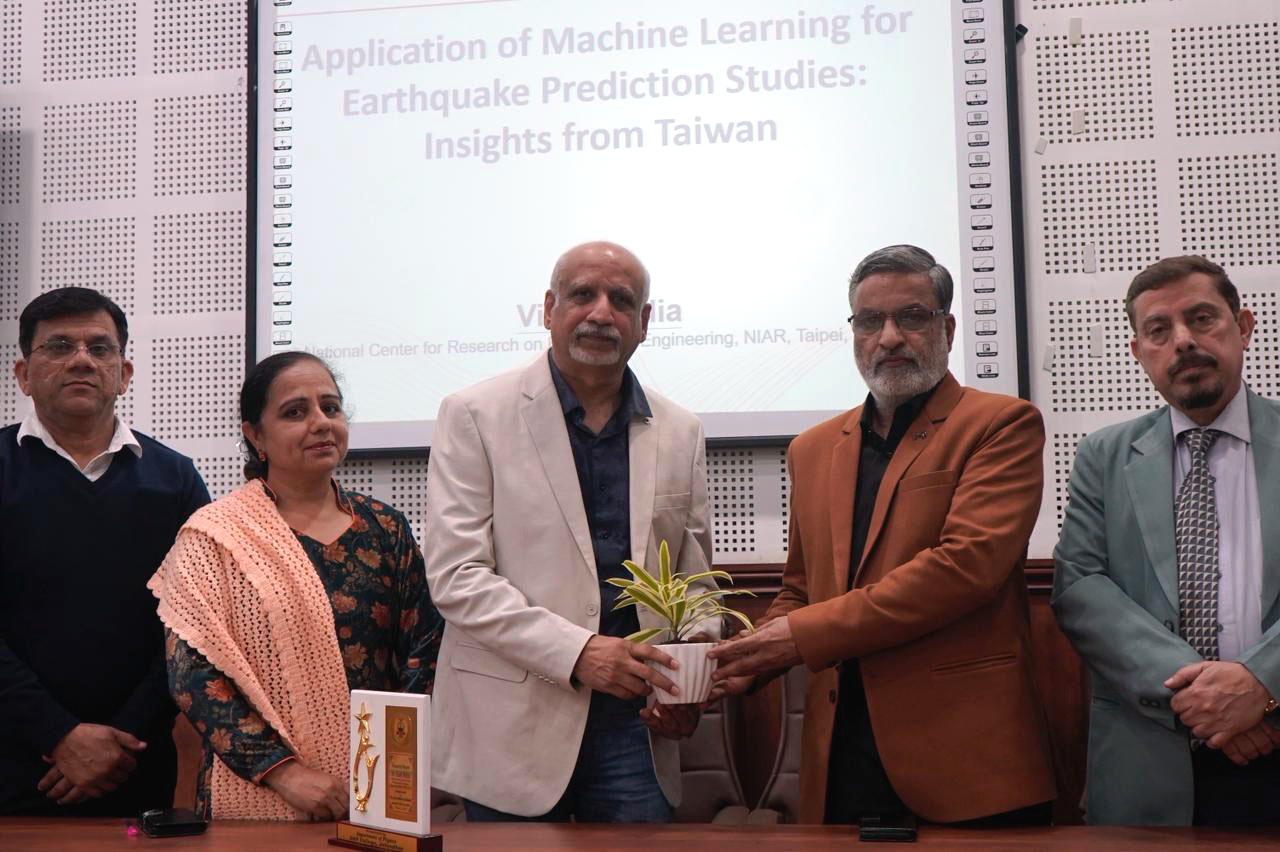
Jalandhar: The Department of Physics, DAV College, Jalandhar, organized an Extension Lecture on “Use of AI in Prediction of Earthquake” under the DBT Star College Scheme. The event aimed to enhance students’ understanding of the application of Artificial Intelligence (AI) in earthquake prediction and disaster mitigation, thereby fostering awareness of advanced technologies in geophysical research.
The resource person, Dr. Vivek Walia, was a distinguished Research Fellow at the National Center for Research on Earthquake Engineering (NCREE), NARL, Taiwan, and an eminent expert in earthquake engineering and AI-based prediction models
The programme commenced with a formal welcome of the esteemed guest and dignitaries. The event was organized under the guidance of Principal Dr. Anoop Kumar, Vice Principal and Head, Department of Physics, Dr. Kunwer Rajeev, DBT Coordinator Dr. Sharanjit Sandhu, Dean Academic Dr. Navjeet Sharma and Dr. Shivani, Professor In-charge, Department of Physics. Faculty members of the Physics Department and a large number of undergraduate and postgraduate students actively participated in the session.
During the lecture, the speaker provided an insightful overview of earthquake mechanisms, seismic wave propagation, and traditional prediction methods. He then elaborated on the role of Artificial Intelligence and machine learning algorithms in analyzing seismic data, identifying early warning signals, and improving the accuracy of earthquake forecasting. Real-life case studies and recent research outcomes were discussed to demonstrate the effectiveness of AI-based predictive models.
The session also highlighted the importance of AI in disaster management, risk assessment, and early warning systems, emphasizing how advanced technologies can significantly reduce loss of life and property. The lecture was highly interactive, with students actively engaging in discussions and raising thoughtful queries, which were addressed in detail by the speaker.
Overall, the extension lecture proved to be highly informative, motivating, and intellectually stimulating. It successfully enhanced participants’ understanding of the interdisciplinary applications of physics, artificial intelligence, and geoscience, thereby contributing significantly to academic enrichment and scientific awareness among students.